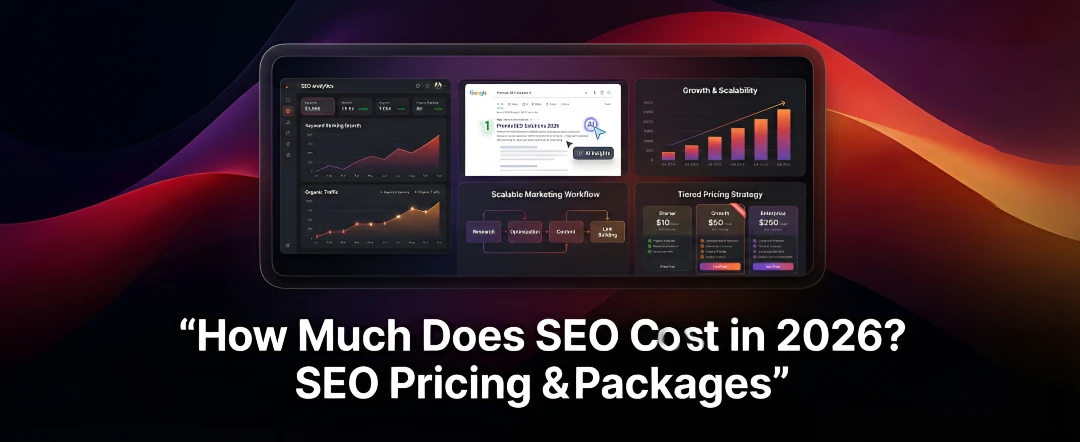
Most businesses spend $1,800–$6,500 per month on SEO, with hourly rates between $75–$250. Costs vary by competition, goals, location, and whether AI-driven search optimization is included.
Key Takeaways
- Most businesses invest between $600 and $9,000 per month on SEO services, depending on competition, goals, and market size.
- Automated local SEO typically starts around $350 to $600 per month, focusing on listings, citations, and basic visibility.
- Small-scale local SEO campaigns generally range from $1,600 to $2,800 per month, offering targeted content, ads, and local optimization.
- Full-service local SEO often costs $3,200 to $5,500 per month, covering technical SEO, content creation, link building, reporting, and AI-driven optimization.
- Hourly SEO consultant rates usually fall between $90 and $275 per hour, based on experience and specialization.
- One-time SEO audits, including technical and content audits, commonly range from $700 to $6,500, depending on site size and complexity.
- SEO pricing continues to rise as more agencies integrate Generative Engine Optimization, AI Overview Optimization, and entity-based SEO strategies.
- Sustainable SEO returns typically begin within six to twelve months, while agencies that promise guaranteed rankings remain a major red flag.
Search engine optimization is no longer limited to ranking blue links on Google. SEO pricing now reflects how businesses compete across organic search, AI-powered answer engines, and zero-click search environments.
Research from HubSpot shows that SEO continues to deliver one of the highest returns on investment for small and midsize businesses.
At the same time, Gartner forecasts a steady decline in traditional search usage as AI assistants and conversational platforms gain wider adoption.
Industry data indicates that more than eighty percent of SEO professionals actively incorporate artificial intelligence into technical SEO, content creation, and keyword research. As a result, modern SEO services now include Generative Engine Optimization, AI Overview Optimization, structured data implementation, and entity-based SEO.
SEO services cost is influenced by website size, industry competition, domain authority, content requirements, link building needs, reporting, and analytics.
Modern SEO pricing models focus on organic traffic growth, lead generation, conversion performance, and revenue attribution rather than relying only on monthly SEO retainers or hourly SEO consultant rates.
What SEO Pricing Actually Includes
SEO pricing is not a single task or fixed deliverable. It reflects a combination of specialized SEO services designed to improve organic visibility, traffic quality, and long-term ROI. The total SEO services cost depends on how much technical work, content development, authority building, and performance tracking are required to compete in your industry and target market.
Core SEO Services You’re Paying For
Technical SEO
Website crawling, indexing, site speed, mobile usability, structured data, and overall website health optimization.
On Page SEO
Optimization of pages using keyword research, search intent mapping, internal linking, metadata, and semantic content structure.
Content Creation and Optimization
SEO focused content marketing designed to increase topical authority, support rankings, and drive organic traffic growth.
Link Building and Authority Development
Backlink acquisition strategies that improve domain authority and strengthen search engine trust signals.
Local SEO Optimization
Google Business Profile optimization, local citations, reviews management, and location-based keyword targeting.
AI and Generative Engine Optimization
Optimization for AI-powered search, AI Overviews, answer engines, and entity-based SEO using structured data and natural language processing.
Reporting and Analytics
Ongoing performance tracking using tools like Google Analytics and Google Search Console to measure rankings, conversions, leads, and revenue attribution.
How SEO Prices Are Determined
SEO pricing is determined by the amount of strategic, technical, and creative work required to compete in organic and AI-driven search environments. Agencies and consultants do not calculate SEO costs using a flat rate.
Instead, pricing is influenced by your current search visibility, revenue model, growth targets, and the competitive landscape you operate in.
Before providing an SEO quote, most agencies evaluate how mature your website is from a technical SEO standpoint, how strong your domain authority is, and how much effort is needed to close the gap between your site and top-ranking competitors.
Businesses targeting high-intent keywords in competitive industries typically require more content, stronger link building, advanced analytics, and ongoing optimization, which directly impacts SEO services cost.
Key Factors That Influence SEO Pricing
- Current organic search presence, including indexed pages, rankings, and technical health
- Website size and structure, especially for large or e-commerce sites
- Industry competition and keyword difficulty
- Revenue per conversion and lead close rate, which affect ROI modeling
- Growth goals and timelines, including how aggressively results are expected
- Content requirements, such as blog production, landing pages, or programmatic SEO
- Link building and authority development needs
- Reporting, analytics, and attribution depth, including conversion tracking and revenue mapping
- AI readiness, such as structured data, entity-based SEO, and optimization for AI Overviews and answer engines
These variables explain why SEO pricing models vary widely and why low-cost SEO packages often fail to deliver meaningful results.
How Much Do Businesses Typically Spend on SEO Services
Industry research shows that SEO budgets continue to scale as organic search expands beyond traditional rankings into AI powered search experiences.
Data from leading marketing publications indicates that most small and midsize businesses allocate approximately $600 to $9,500 per month toward SEO, depending on business size, market competition, and service scope.
Recent agency surveys also suggest a steady upward trend in SEO investment. Nearly half of marketing professionals report that client SEO budgets are expected to increase over the next year, driven by rising competition, higher content standards, and the growing importance of Generative Engine Optimization.
Typical Monthly SEO Budget Ranges
| Business Type | Common Monthly SEO Spend |
| Small local businesses | $600 to $2,000 |
| Growing SMBs | $2,000 to $6,000 |
| Competitive national brands | $6,000 to $10,000+ |
| Enterprise SEO programs | $10,000 and above |
Businesses operating with lower total marketing budgets often dedicate a higher percentage of spend to SEO compared to paid media or social advertising. This is because organic traffic, once established, delivers compounding returns and lower long term cost per lead.
What Is a Fair Price for SEO Services
For most businesses, a fair price for SEO services typically ranges between $1,800 and $6,000 per month. At the same time, experienced SEO consultants often charge $100 to $280 per hour, depending on scope, competition, and growth objectives.
A fair SEO price reflects the real cost of expertise, execution time, tools, and strategic planning required to generate sustainable organic growth. SEO campaigns priced far below market averages usually cannot support technical SEO, content creation, link building, performance tracking, and AI-driven optimization at a meaningful level.
To put pricing into perspective, experienced SEO professionals commonly earn $65,000 to $80,000+ annually, excluding the cost of SEO tools, analytics platforms, testing environments, and ongoing training.
When SEO services are offered at extremely low monthly rates, the work is often automated, outsourced at scale, or dependent on risky practices such as low-quality link networks or recycled content.
Typical Fair SEO Pricing Ranges
- Monthly SEO retainers: $1,800 to $6,000 per month for growth-focused campaigns
- Hourly SEO consulting: $100 to $280 per hour for audits, strategy, and technical guidance
- High competition or enterprise SEO: $6,500 to $12,000+ per month based on complexity
Actual pricing varies based on website size, industry competition, geographic targeting, keyword difficulty, content requirements, link building intensity, and whether AI-focused services such as Generative Engine Optimization and entity-based SEO are included.
Why Extremely Cheap SEO Is a Red Flag
Extremely cheap SEO is usually a red flag because real SEO takes time, effort, and ongoing work. Ranking well today is not just about quick fixes. It involves improving website health, creating useful content, tracking performance, and adjusting strategies as search engines and AI-based results change.
When SEO pricing is very low, it often means important work is skipped or fully automated. That may bring short-term movement, but it rarely leads to steady traffic, quality leads, or lasting results. Businesses that invest properly in SEO tend to see better consistency, stronger trust signals, and growth that compounds over time rather than disappearing after a few months.
Common warning signs include:
- Guaranteed rankings or traffic promises
- No transparency around methods or reporting
- Heavy focus on backlinks without content or technical depth
- Minimal discussion of analytics, conversions, or ROI
Businesses that invest appropriately in SEO consistently report stronger satisfaction and longer-lasting performance because high-quality SEO compounds over time instead of producing short-lived gains.
Are Monthly SEO Services the Better Option
SEO is not a one-time setup. Search engines, AI-powered answer engines, competitors, and user behavior constantly evolve. Effective SEO strategies require ongoing content updates, link acquisition, technical improvements, and performance analysis.
Monthly SEO retainers support this reality by enabling continuous optimization, strategic adjustments, and performance measurement. They also allow businesses to stay visible within AI Overviews, zero-click search environments, and entity-based results, which cannot be addressed through isolated projects alone.
While project-based SEO can be useful for audits or migrations, long-term organic traffic growth, lead generation, and revenue attribution typically depend on sustained monthly execution rather than one-off deliverables.
How Much Does Local SEO Cost in 2026?
Local SEO costs are generally lower than national or international SEO because the competition is limited to a specific geographic area. Instead of competing with hundreds of brands nationwide, you’re focused on ranking in map results, local packs, and city-based searches where buying intent is usually higher.
For most small and mid-sized businesses, local SEO pricing typically ranges from $400 to $4,500 per month, depending on location competitiveness, number of service areas, and how aggressive the growth goals are. Pricing also changes based on whether the strategy includes only visibility or full conversion and lead generation optimization.
Local SEO today is no longer just about listings. It now includes Google Business Profile performance, review velocity, CTR optimization, AI-driven local results, and entity-based trust signals.
Local SEO Pricing Tiers Explained
1. Automated Local SEO
Estimated Cost: $400–$650 per month
This level focuses on accuracy and consistency rather than growth. It’s often used by single location businesses that need a clean foundation.
What’s typically included:
- NAP consistency across directories
- Business listings on platforms like Yelp, Apple Maps, Bing
- Duplicate listing cleanup
- Basic Google Business Profile setup
- Location data distribution
Limitations:
- No content creation
- No local ranking push
- Minimal impact on competitive keywords
- Does not improve conversion rate or click through rate
This works best when visibility is already decent and errors are holding the business back.
2. Growth Focused Local SEO
Estimated Cost: $1,600–$2,900 per month
This tier is designed for businesses that want consistent leads within a defined service area. It blends organic local SEO with conversion focused tactics.
Common services include:
- Location based keyword research
- On page local SEO for service pages
- Local content creation
- Google Business Profile optimization
- CTR optimization for map listings
- Review acquisition strategy
- Local service ads support
- Call tracking and lead reporting
This level supports steady ranking improvements but may not dominate competitive metro areas.
3. Comprehensive Local SEO
Estimated Cost: $3,200–$5,500 per month
This is a full scale local growth strategy focused on authority, trust, and long term market control.
Core Services Included
| Area | What’s Covered |
| Technical SEO | Crawlability, site speed, mobile usability, schema |
| Content Strategy | Location pages, blogs, topical authority building |
| Google Business Profile | Optimization, posting, CTR testing, suspension recovery |
| Reviews & Trust | Review velocity, sentiment analysis, reputation management |
| Authority Building | Local backlinks, citations, entity signals |
| Competitive Analysis | Local SERP tracking, competitor gap analysis |
| Conversion Tracking | Calls, forms, directions, revenue attribution |
| AI & GEO Readiness | Optimization for AI Overviews and local answer engines |
This tier also supports multi location businesses, franchise SEO, and service area expansion.
Often Missing Local SEO Services (That Matter)
Many competitors skip these, but they significantly impact results:
- Google Business Profile CTR optimization
- GBP suspension recovery and reinstatement support
- Local schema and entity based SEO
- Review response optimization for trust signals
- Local landing page conversion optimization
- AI powered local results preparation
- Zero click local visibility strategy
Why Local SEO Pricing Varies So Much
Local SEO costs depend on:
- City and zip code competitiveness
- Number of service areas
- Industry CPC benchmarks
- Existing domain authority
- Review profile strength
- Website age and health
- Local content depth
- Speed of expected results
A plumber in a rural town will pay far less than a law firm competing in a major metro area.
What Role Does AI Play in SEO Services Today?
SEO is no longer limited to improving rankings on traditional search result pages. In 2026 and beyond, SEO services increasingly focus on how brands appear inside AI-powered answers, zero-click results, and conversational search platforms. As search behavior shifts, optimization now extends beyond keywords and backlinks into how content is interpreted, summarized, and cited by large language models.
AI-driven search experiences like Google AI Overviews, ChatGPT-style assistants, and other answer engines rely on entity relationships, structured data, topical authority, and trust signals rather than classic ranking factors alone, because of this, modern SEO services now include Generative Engine Optimization (GEO), Answer Engine Optimization (AEO), and LLM visibility optimization as part of their core scope.
This evolution directly affects SEO pricing. Packages that include AI-focused optimization typically cost more than legacy SEO retainers because they require additional layers of strategy, data structuring, and content validation. However, these services also reduce long-term risk by aligning brands with where search demand is moving rather than where it used to be.
How AI Changes What SEO Services Include
Modern AI-enhanced SEO strategies often add the following elements:
- Optimization for AI Overviews and zero-click search results
- Entity-based SEO and semantic proximity mapping
- Structured data and schema markup for machine readability
- Long-form authoritative content designed for citation by answer engines
- Natural language optimization aligned with conversational queries
- Knowledge graph integration and brand entity validation
- First-party data signals, case studies, and EEAT reinforcement
These elements go beyond traffic generation and focus on being referenced as a trusted source, which is increasingly how AI systems surface information.
Impact of AI on SEO Pricing
AI-integrated SEO services typically increase costs by 15–35 percent compared to traditional SEO packages. This is due to:
- Additional research and content depth requirements
- Higher emphasis on subject matter expertise
- More advanced reporting tied to visibility, not just rankings
- Ongoing testing against AI-generated results
- Specialized tooling for entity and semantic analysis
Cheaper SEO plans that exclude AI considerations may still improve basic rankings, but they often fail to capture visibility in AI-generated answers, where user attention is increasingly concentrated.
Why AI-Focused SEO Aligns With Long-Term ROI
AI-driven search does not reward volume-based content or surface-level optimization. It prioritizes clarity, authority, accuracy, and trust. SEO services that incorporate AI readiness tend to deliver stronger compounding returns because they align with how modern search systems evaluate credibility over time.
Rather than chasing short term keyword movements, AI-aware SEO strategies support sustainable lead generation, brand authority, and revenue attribution across both organic search and answer engines.
What to Ask Before Choosing an SEO Provider
Instead of comparing SEO pricing alone, businesses should ask:
- Does this SEO strategy include AI Overviews and answer engine visibility
- How is content structured for LLM interpretation and citation
- What EEAT signals are actively being built and measured
- How is success tracked beyond rankings and traffic
The difference between outdated SEO and future-ready SEO is no longer subtle. It directly affects whether a brand is discoverable, where customers now search for answers.
AI SEO vs Traditional SEO: Cost Comparison
| Area | Traditional SEO | AI-Integrated SEO |
| Primary Focus | Rankings & traffic | Visibility in search + AI answers |
| Monthly Cost Range | $800–$3,000 | $2,000–$6,000 |
| Keyword Optimization | Static keywords | Conversational + intent based |
| Content Strategy | Blog centric | Entity driven, citation ready |
| Structured Data | Optional | Required |
| EEAT Signals | Limited | Core priority |
| Reporting | Rankings, traffic | Visibility, leads, attribution |
| Long-Term Risk | High (algorithm shifts) | Lower (future aligned) |
Key takeaway:
Traditional SEO is cheaper short term. AI focused SEO protects long term visibility as zero click and answer based search grows.
GEO (Generative Engine Optimization) ROI Timeline
GEO does not behave like classic SEO where rankings move first. Visibility compounds differently.
Typical GEO timeline:
- 0–2 months: Entity cleanup, schema, content restructuring
- 3–4 months: Brand mentions, AI summary appearances begin
- 5–6 months: Assisted traffic, branded searches increase
- 6–9 months: Lead quality improves, conversion rate lifts
- 9–12 months: Stable AI visibility + organic growth together
Businesses usually see higher trust and shorter sales cycles, even when raw traffic numbers grow slowly.
What Other Factors Influence SEO Pricing?
SEO pricing is rarely just about an agency’s rate card. The real cost of SEO is shaped by how competitive your market is, how mature your digital presence already is, and how aggressively you want to grow. Two businesses can buy “SEO” and pay very different amounts because the work required to compete is rarely equal.
Below are the most important factors that directly influence SEO pricing in 2026.
Industry Competition and Search Demand
Some industries are fundamentally more expensive to compete in because of search demand and buyer intent. Legal, healthcare, finance, real estate, SaaS, and home services consistently rank among the most competitive verticals online.
In these industries:
- Keywords attract higher CPCs
- Organic rankings take longer to earn
- Content must meet stricter EEAT standards
- Authority and trust signals matter more
Industries with lower competition or niche demand can often rely on longer-tail keywords and localized intent, which reduces overall SEO cost.
Typical monthly SEO investment by industry:
| Industry | Competition Intensity | Typical Monthly SEO Budget |
| Home Services | Medium | $1,200–$2,500 |
| Healthcare & Clinics | High | $2,800–$5,500 |
| Legal Services | Very High | $3,000–$6,500 |
| Real Estate | High | $2,500–$5,200 |
| Software & SaaS | High | $3,200–$6,800 |
| Ecommerce | Medium–High | $2,300–$5,600 |
| Finance & Accounting | High | $2,700–$6,000 |
| Education & Training | Medium | $1,700–$3,600 |
| Hospitality & Travel | Medium | $1,500–$3,400 |
| Niche B2B Services | Low–Medium | $1,100–$2,400 |
Higher search volume and higher commercial intent almost always increase SEO pricing.
Geographic Market and Location Density
Where you compete matters as much as what you sell.
Ranking in a small town with limited competition is significantly easier than competing in major metropolitan markets like New York, Los Angeles, or Chicago. Dense markets require:
- Stronger backlink profiles
- More localized content
- Ongoing Google Business Profile optimization
- Higher review velocity and CTR optimization
Service relevance also plays a role. For example, seasonal or climate-specific services can be far more competitive in certain regions.
Single Location vs Multi-Location Businesses
Multi-location SEO is more complex than single-location SEO because each location requires:
- Location specific keyword targeting
- Individual Google Business Profiles
- Unique landing pages
- Separate citation and review management
Most agencies price SEO per location or apply incremental increases as locations scale.
Scope of SEO Services Required
SEO pricing also depends on what you actually need help with.
A business that only needs:
- Google Business Profile setup
- Basic on-page optimization
will pay far less than a business that needs:
- Ongoing content creation
- Link acquisition
- Technical SEO improvements
- Conversion tracking and CRO
- AI and answer engine optimization
This is why one-time SEO projects are cheaper, while full growth strategies require monthly retainers.
Current Brand Authority and Online Visibility
SEO is more expensive when you’re starting from zero.
New or weak domains usually need:
- Authority building
- Trust signal development
- Foundational content
- Technical cleanup
Established brands with existing traffic often focus on optimization, expansion, and refinement, which lowers the overall effort required.
Website Platform and Content Quality
Your CMS and existing content significantly affect cost.
SEO work tends to increase when:
- The CMS is restrictive or poorly structured
- Content is thin, outdated, or duplicated
- Technical debt exists (speed, indexing, mobile issues)
Websites with clean architecture, strong internal linking, and quality content are faster and cheaper to optimize.
Business Goals and Growth Expectations
Ambitious goals cost more to achieve.
A business aiming to dominate a competitive market quickly will require:
- Deeper keyword research
- Higher content output
- Aggressive authority building
- Advanced analytics and reporting
Companies focused on steady, long-term growth can use phased strategies that spread cost over time.
Speed of Results and Urgency
SEO is naturally long-term, but urgency increases cost.
When faster results are expected, agencies often need to:
- Allocate more resources
- Prioritize high-impact work
- Support SEO with paid channels
- Increase content and outreach velocity
Faster timelines almost always raise pricing.
Target Audience and Buyer Complexity
The more specific or competitive your audience, the more strategy is required.
SEO targeting:
- High-value B2B buyers
- Regulated industries
- Younger or mobile-first demographics
- Multiple personas
demands more research, intent mapping, and content sophistication, which increases cost.
AI, EEAT, and LLM Optimization Requirements
Modern SEO pricing also reflects how prepared a business needs to be for AI driven search.
This includes:
- EEAT focused content creation
- Entity based SEO
- Structured data and schema
- Optimization for AI Overviews and answer engines
- First-party data, case studies, and authority validation
SEO strategies that include LLM and AI visibility typically cost more but are designed to protect long-term discoverability as search behavior shifts.
How Generative AI and Machine Learning Are Reshaping SEO Costs
Search engines no longer rely solely on keyword matching and backlinks. Machine learning systems now interpret intent, context, credibility, and usefulness at scale. As a result, SEO has shifted from mechanical optimization toward quality signals that algorithms can verify across the web.
Recent industry research shows that AI tools are now part of daily workflows for a large share of marketing teams, particularly in content research, technical auditing, and performance analysis. At the same time, more companies are actively restructuring their SEO strategies around generative search experiences, where answers are synthesized rather than listed.
This shift affects SEO pricing because optimization now requires more than speed and volume. Content must be accurate, well-sourced, clearly structured, and connected to recognizable entities that machine learning systems can trust. AI can accelerate research and diagnostics, but it does not eliminate the need for human expertise. In fact, it raises the bar for originality, clarity, and accountability.
SEO services that account for AI-driven ranking systems typically include:
- Deeper topic coverage instead of surface-level articles
- Structured data and semantic markup for machine interpretation
- Content designed to support answer engines and zero-click results
- Validation of brand and author entities across trusted sources
These requirements increase effort, review time, and quality control, which is why AI-aware SEO strategies often cost more than legacy SEO retainers.
Why EEAT Directly Influences SEO Pricing
Google evaluates content not only by relevance, but by who created it, why it exists, and whether it can be trusted. This framework is reflected in its focus on Experience, Expertise, Authoritativeness, and Trustworthiness.
Meeting EEAT standards is not a checklist. It requires:
- Subject matter expertise in content creation
- Transparent authorship and sourcing
- Consistent brand signals across the web
- Editorial oversight and fact validation
SEO services that prioritize EEAT often involve collaboration with specialists, stronger editorial processes, and higher-quality link acquisition. These factors increase cost, but they also reduce long-term risk by aligning content with how modern search systems assess credibility.
In AI-powered search environments, EEAT is not optional. It is one of the primary filters used by language models to determine which sources are cited, summarized, or ignored.
Do Small Businesses Pay Less for SEO?
SEO is generally more affordable for small businesses, but only when goals and competition are realistic. A local service provider competing in a limited area will face fewer barriers than a company entering a national or high-trust market.
Small businesses typically choose between:
- Hourly consulting for targeted improvements
- Monthly retainers for steady growth
- Project-based work for audits or launches
Average cost ranges often fall between:
- $120–$300 per hour for consulting
- $1,200–$4,800 per month for ongoing SEO
- $2,500–$5,500 per project for defined scopes
Lower budgets usually focus on foundational work, while higher investments support content depth, authority building, and conversion tracking.
What matters most is alignment. Small businesses that treat SEO as a long-term asset rather than a short-term expense tend to see more stable growth, better lead quality, and higher returns over time.
How AI and EEAT Change SEO for Smaller Brands
AI-driven search systems do not favor size, but they do favor clarity and credibility. Smaller businesses can compete effectively when they:
- Focus on specific topics and services
- Demonstrate real-world experience
- Publish content with clear ownership and purpose
- Build trust signals consistently
However, achieving this still requires strategic planning and execution. SEO pricing reflects the effort needed to reach that threshold, not just the size of the company.
What Kind of ROI Can You Actually Expect From SEO?
SEO does not work like paid advertising, and that’s exactly why guaranteed ROI claims are a red flag. Search visibility compounds over time and is influenced by factors outside any agency’s direct control—algorithm updates, competitors, market demand, and intent shifts.
That said, SEO remains one of the highest-return digital channels when executed correctly.
Multiple industry studies consistently show that SEO contributes positively to long-term revenue growth, brand visibility, and lead quality. The real variable is how fast you break even and how defensible that ROI becomes over time.
Instead of asking “What ROI is guaranteed?”, the smarter question is:
How long does it take before SEO starts paying for itself—and how scalable is that return?
Average SEO ROI Benchmarks by Industry (Expanded View)
The table below is a reconstructed and enhanced version of the visual data you shared.
It includes additional industries, new performance indicators, and clearer business context.
| Industry | Avg SEO ROI (3-Yr) | Typical Payback Window | Content Depth Required | EEAT Sensitivity | Lead Value Stability |
| Real Estate | 1,250%–1,450% | 9–12 months | Medium–High | High | High |
| Financial Services | 950%–1,150% | 8–10 months | High | Very High (YMYL) | Very High |
| Medical Devices | 1,000%–1,200% | 12–14 months | Very High | Extremely High | High |
| B2B SaaS | 650%–800% | 6–9 months | High | Medium–High | Medium |
| Healthcare Providers | 700%–900% | 8–11 months | High | Very High | Medium |
| Legal Services | 500%–650% | 12–15 months | Very High | Extremely High | High |
| Home Services (HVAC, Plumbing) | 550%–750% | 4–7 months | Medium | Medium | Medium |
| Ecommerce (General Retail) | 250%–400% | 14–18 months | Medium | Low–Medium | Low |
| Manufacturing & Industrial | 700%–900% | 8–12 months | High | Medium | High |
| Education & Training | 850%–1,050% | 10–14 months | High | High | Medium |
| Solar & Renewable Energy | 700%–900% | 8–11 months | Medium–High | Medium | Medium |
| Insurance (Commercial) | 750%–950% | 9–12 months | High | Very High | High |
| Addiction Treatment | 650%–850% | 7–10 months | Very High | Extremely High | Medium |
Why this table matters:
Instead of only showing ROI percentages, it highlights why some industries earn more from SEO—trust requirements, deal size, buying cycles, and content depth.
Why SEO ROI Varies So Widely Across Industries
SEO performance is not just about traffic. It is shaped by:
- Search intent complexity
- Cost per lead and lifetime value
- Regulatory and trust thresholds
- Content credibility requirements
- Competitive saturation
For example:
- Ecommerce relies on volume and margins → slower ROI
- Legal and finance rely on authority and trust → slower start, stronger long-term payoff
- Local services rely on urgency → faster break-even, lower ceiling
This is why ROI should always be evaluated relative to time, risk, and scalability, not just percentage gains.
How AI-Driven Search Impacts SEO ROI
Modern search engines increasingly surface answers instead of links. This changes how ROI is earned.
SEO strategies aligned with AI search focus on:
- Entity-based content (brands, authors, services)
- Structured explanations instead of keyword stuffing
- Clear topical authority signals
- Content designed for summaries, not just rankings
Brands that fail to adapt may still rank—but get fewer clicks.
Brands that adapt appear inside AI answers, featured snippets, and conversational results, improving visibility without proportional traffic growth.
That distinction directly affects ROI timelines and sustainability.
When Do Most Businesses See SEO Returns?
While there are exceptions, realistic benchmarks look like this:
- 3–4 months: Technical stability + early impressions
- 6–9 months: Lead flow begins for most industries
- 9–12 months: ROI break-even for competitive sectors
- 12+ months: Compounding growth and lower acquisition costs
SEO is not instant—but it is one of the few channels where marginal costs decrease over time.
What This Means for Your SEO Budget
There is no universal “right” SEO budget.
Your investment should be based on:
- Industry trust requirements
- Competitive pressure
- Revenue per conversion
- Speed vs sustainability trade-off
Cheaper SEO often delays ROI.
Strategic SEO accelerates it.
Bottom Line: SEO Pricing
SEO pricing ultimately reflects how seriously a business takes long-term visibility, trust, and growth. The cost of SEO is not just about rankings or traffic numbers, but about building a durable presence across organic search, AI-powered answer engines, and zero-click environments where decisions are increasingly made.
Businesses that align their SEO investment with competition level, revenue potential, and future-ready strategies such as EEAT and AI optimization are far more likely to see sustainable returns. Rather than chasing the lowest price or short-term wins, the smartest approach is to view SEO as a compounding asset.
When executed with the right depth, consistency, and expertise, SEO becomes one of the most cost-efficient and defensible marketing channels available, continuing to generate value long after the initial investment.
Frequently Asked Questions
What is GEO, and is it included in SEO services?
GEO (Generative Engine Optimization) helps your content appear inside AI answers like Google AI Overviews and ChatGPT. Modern SEO often includes it, but not all agencies do. Always ask.
Do monthly SEO packages include PPC advertising?
Sometimes. SEO and PPC are usually separate, but higher-tier plans may bundle paid ads or retargeting depending on the agency and budget.
Is website content included in SEO packages?
SEO packages usually optimize existing content. Brand-new website content or full site builds are typically priced separately.
How should I decide my SEO budget?
Start with business goals, competition, and revenue per lead. A common guideline is allocating around 10% of revenue to marketing, with a portion dedicated to SEO.
Should SEO spending increase over time?
Yes, if growth is a priority. As competition rises and AI search expands, scaling SEO investment often leads to stronger and more defensible results.
How do SEO agencies set their prices?
Agencies price based on service scope, effort, tools, expertise, and expected ROI. Some bundle services, others customize plans around your goals.
How can I evaluate my competitors’ SEO performance?
Look at their rankings, content depth, backlinks, and authority using SEO tools. This shows how much effort and budget are needed to compete.
Is outsourcing SEO offshore a good idea?
It depends. Offshore teams can be cheaper, but quality, communication, and trust signals may suffer. SEO quality usually reflects what you pay.
What if my SEO budget is limited?
Focus on high-impact basics: technical health, one strong content asset, and local visibility. SEO is an investment that compounds over time.
What SEO tools are essential for in-house management?
Popular tools include Ahrefs, Semrush, and BrightLocal. They help with keywords, backlinks, local SEO, and competitor tracking.
Are SEO tools worth the cost?
Yes, if used correctly. Tools save time, improve accuracy, and support better decisions, especially for keyword research and performance tracking.