Search engines are no longer just directories. They are intelligent systems that read context, understand intent, and generate answers before a user even clicks a link. In 2026, ranking on Google is only one piece of a much larger puzzle.
AI Overviews, Large Language Models like ChatGPT and Perplexity, zero-click results, and persona-driven content have completely rewritten the rules of organic visibility. Businesses still relying on outdated keyword tactics are quietly losing ground to competitors who have already adapted.
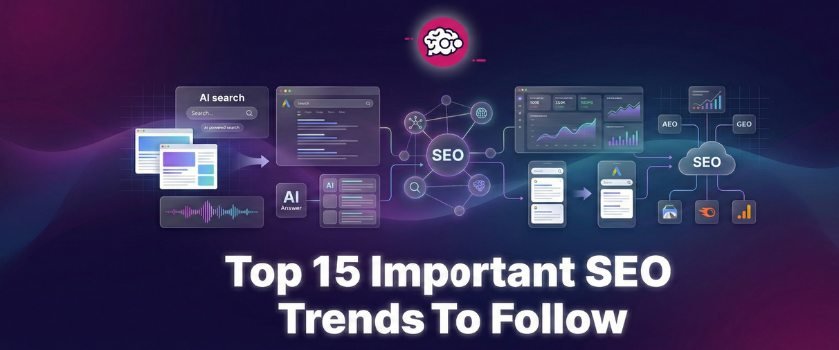
This guide breaks down 15 SEO trends shaping search in 2026 and beyond, from Generative Experience Optimization and topical authority to technical performance and local signals. Whether you are a small business or a growing brand, understanding these shifts is no longer optional. It is your competitive baseline for your online presence.
Top 15 SEO Trends To Follow
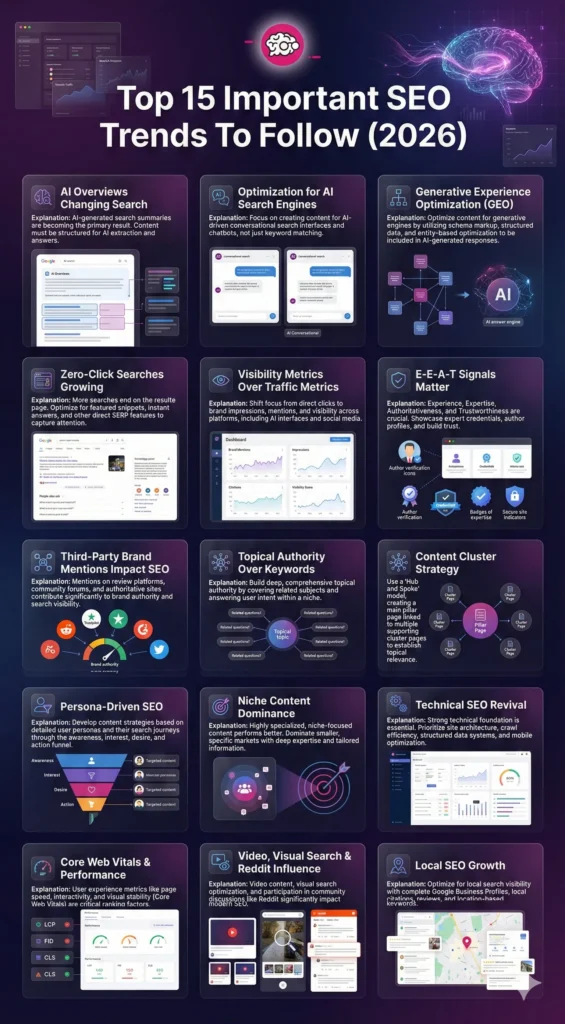
Trend 1: AI Overviews Are Changing Search Results
Google’s AI Overviews have fundamentally shifted how search results are displayed. Instead of a traditional list of blue links, users now see AI-generated summaries pulled from multiple trusted sources sitting right at the top of the page. Studies show AI Overviews appear in over 25% of all searches, and that number keeps climbing.
For businesses, this creates a double-edged situation. Organic clicks are dropping because users get answers without visiting any website. But brands that get cited inside these summaries gain massive visibility, sometimes more than a first-page ranking ever delivered.
The key to appearing here is producing content that is clear, factually accurate, well-structured, and backed by credible sources. Schema markup, proper heading hierarchy, and authoritative internal linking all help Google’s systems extract and surface your content.
Businesses that ignore this shift will lose ground fast, while those who adapt early will dominate SERP features consistently.
If you are still weighing whether SEO investment makes sense for your business, understanding the core reasons behind it can help clarify the decision before diving into specific trends.
As a B2C business owner, you can verify this yourself. Open Google Search Console and check your impressions versus clicks over the last six months. If impressions are steady but clicks are falling, AI Overviews are already intercepting your traffic. That gap is your signal to act.
Trend 2: Optimization for AI Search Engines
Search behavior has expanded far beyond Google. Millions of users now turn to ChatGPT, Perplexity AI, and other Large Language Models to find recommendations, compare options, and make decisions.
These platforms do not crawl the web the same way traditional search engines do. They rely on training data, real-time web access, and third-party signals to compose answers.
This means your content strategy must go beyond ranking on Google and focus on being present across the broader digital ecosystem.
Getting mentioned on review platforms, industry directories, Reddit threads, and authoritative publications increases the chances of LLMs citing your brand.
Conversational content that answers specific questions directly performs significantly better in these environments than keyword-heavy pages.
Businesses that treat AI search engines as a separate channel, and optimize accordingly, are already capturing traffic and leads that their competitors are completely unaware they are losing.
Trend 3: Generative Experience Optimization (GEO)
Generative Experience Optimization, commonly referred to as GEO, is one of the most important strategic shifts in modern SEO. It refers to the practice of structuring and formatting content so that AI-powered search systems can easily read, understand, and recommend it.
Unlike traditional SEO which focused heavily on keyword placement and backlinks, GEO prioritizes content clarity, factual depth, and topical authority. Search Generative Experience (SGE) from Google pulls information from sources it considers reliable and well-organized.
To qualify, your content needs to demonstrate E-E-A-T signals, answer questions comprehensively, and use structured data where relevant. Brands investing in GEO now are seeing up to 40% increases in AI-driven visibility.
This is not a future trend to bookmark for later. It is an active shift happening inside search results today. Companies that build GEO into their content marketing strategy will hold a significant advantage as AI search continues to mature and expand.
To check whether your content is being picked up by AI platforms, simply ask ChatGPT or Perplexity a question your business should answer and see if your brand appears anywhere in the response. If a competitor shows up instead of you, that is a GEO gap worth fixing immediately.
Trend 4: Zero-Click Searches Are Increasing
Zero-click searches occur when a user types a query and gets their answer directly on the results page without clicking any link.
Featured snippets, knowledge panels, AI summaries, and instant answer boxes all contribute to this behavior. Data from early 2025 confirmed that fewer than 41% of Google searches in the United States resulted in an actual website click. That number continues to decline.
For businesses, this sounds alarming, and in some ways it is. But zero-click visibility still carries real value. Appearing in a featured snippet or knowledge panel builds brand recognition and trust, even without a visit. Users remember the names they see. The strategy here is not to avoid these placements but to actively pursue them.
Optimizing content for position zero, using clear question-and-answer formats, adding FAQ schema, and building topical authority all increase your chances of owning these high-visibility spots where most user attention now lands.
Trend 5: Visibility Metrics Are Replacing Traffic Metrics
For years, monthly organic traffic was the headline number every SEO report opened with. That single metric no longer tells the full story.
In 2026, brands that only measure clicks are missing the majority of where influence actually happens. AI Overviews, SERP features, brand mentions on Reddit, citations inside ChatGPT answers, and appearances in comparison articles all shape buying decisions before a user ever lands on your website.
Share of voice, search impressions, brand mention sentiment, and LLM citation frequency are becoming the metrics that actually reflect SEO performance. A business could see flat traffic while its brand is being recommended inside hundreds of AI-generated answers daily.
That is a pipeline moving without a single recorded session. Smart teams are now building dashboards that track visibility across traditional search, AI platforms, and third-party sources together. Tying those visibility gains to downstream conversions is what separates modern SEO strategy from outdated reporting habits.
If you have an SEO team or agency working for you, ask them to show you a monthly report that includes Google Search Console impressions, keyword ranking movement tracked through SEMrush or Ahrefs, and brand mention data.
If their report only shows traffic numbers and nothing else, that is a red flag. Modern SEO reporting should connect visibility to leads, not just sessions.
If you are evaluating whether your current SEO investment is structured correctly, understanding what a proper SEO engagement actually costs and what it should include is a useful starting point.
Trend 6: E-E-A-T Is a Major Ranking Signal
Google’s E-E-A-T framework, which stands for Experience, Expertise, Authoritativeness, and Trustworthiness, has moved from a quality guideline to an active ranking factor that shapes search visibility in 2026.
Search engines are getting better at distinguishing genuinely knowledgeable sources from content that simply sounds credible.
For businesses, this means publishing content written or reviewed by people with real credentials, real experience, and verifiable knowledge in their field.
A plumbing company sharing firsthand insights about pipe materials performs better than a generic article written without industry knowledge.
Trust signals like online reviews, accurate business information, consistent brand mentions across platforms, and authoritative backlinks all feed into how Google evaluates your site.
Thin content and AI generated filler work against E-E-A-T because they add nothing new. Businesses that invest in genuine expertise, whether through subject matter experts, case studies, or original research, will find their SEO ranking factors improving steadily over time.
At Ideaxperts, our content marketing team works directly with industry specialists to ensure every article reflects real knowledge, not recycled information. When we build content strategies for clients, we start by identifying the specific credentials and firsthand experience their audience needs to see before trusting a brand.
For business owners trying to understand what on-page SEO work involves and what it should realistically cost, we have broken that down in detail separately.
Trend 7: Third-Party Mentions Influence SEO
Your own website alone is no longer enough to build search authority. Google and AI platforms like ChatGPT and Perplexity evaluate how your brand appears across the broader web before deciding how much weight to give your content.
Third-party signals including mentions on review platforms, industry directories, Reddit discussions, comparison sites, and news publications all contribute to how search engines perceive your credibility.
This is especially relevant for businesses targeting AI-generated answers, since Large Language Models pull from dozens of external sources when composing responses.
A brand consistently mentioned across trusted platforms is far more likely to appear in those answers than one relying solely on its own content. Earning these mentions requires a combination of content marketing, digital PR, and reputation management.
Encouraging customer reviews, contributing to industry publications, and being active in relevant online communities are all practical ways to strengthen third-party signals and improve overall search visibility in 2026.
This is exactly the approach we take at Ideaxperts when building authority strategies for clients.
Before writing a single word of content, we audit where the brand currently stands across third-party platforms using SEO tools like Ahrefs, SEMrush, and Google Search Console to identify citation gaps, unlinked brand mentions, and review platform inconsistencies that are silently suppressing search visibility.
You can do a basic version of this check yourself. Search your business name on Google and note every platform where it appears.
Then check whether your name, address, and phone number are consistent across all of them. Inconsistencies in even one directory send conflicting signals to search engines and AI platforms evaluating your credibility.
If you spot mismatches, tools like Moz Local or BrightLocal let you audit and correct listings across multiple directories from a single dashboard without needing technical knowledge.
However, if managing this alongside running your business feels like too much, this is exactly where hiring a dedicated SEO agency pays for itself. A good agency does not just fix existing inconsistencies.
They monitor new ones before they compound, build your review presence across the right platforms, and ensure your brand signals stay consistent as your business grows.
The difference between a brand that shows up in local AI-generated answers and one that does not often comes down to this level of ongoing maintenance that most business owners simply do not have time to handle alone.
Trend 8: Topical Authority Beats Individual Keywords
Targeting one keyword per page is an outdated approach. Google now evaluates whether a website genuinely understands a subject rather than whether it contains a specific phrase.
Topical authority means covering a subject comprehensively through multiple interconnected pieces of content that together demonstrate deep knowledge.
A website publishing one blog post about SEO strategy will always lose to a website that has covered every angle of that topic, from technical SEO and content clusters to local SEO trends and seo ranking factors. This is how search engines decide who deserves to rank.
Building topical authority requires planning your content around subjects rather than isolated keywords, using internal linking to connect related pages, and updating existing content regularly. It also feeds directly into how AI platforms like ChatGPT and Google AI Overviews choose which sources to cite.
Brands that own a topic in their niche become the default reference point across both traditional search and AI generated results.
Our content marketing packages at Ideaxperts are built entirely around this principle.
Before producing a single piece of content, we combine SEMrush’s Topic Research for subtopic discovery, Ahrefs’ Content Gap analysis to identify what competitors are ranking for that you are not, and Google’s People Also Ask data to understand exactly what questions your audience is searching at every stage of their journey.
We also cross-reference Reddit threads and Quora discussions to surface real language your audience uses, which keyword tools alone never capture. Every piece we produce has a defined role in the larger content structure, not just a target keyword attached to it.
Trend 9: Content Clusters Are the New SEO Strategy
Content clusters, built around the hub and spoke model, have become one of the most effective SEO strategies for 2026. The concept is straightforward. You create one comprehensive pillar page covering a broad topic, then build multiple supporting pages that go deeper into specific subtopics, all linked back to the central hub.
This structure does two things simultaneously. It signals topical authority to Google by showing that your website covers a subject from multiple angles. It also improves site architecture and internal linking, which helps search engines crawl and index your content more efficiently.
For example, a pillar page on SEO strategy 2026 could link to supporting articles on technical SEO trends, local SEO, content marketing SEO, and video SEO. Each spoke page strengthens the hub, and the hub gives authority back to each spoke.
Businesses using this model consistently outperform those publishing scattered, unconnected blog posts targeting isolated keywords with no strategic relationship to each other.
Trend 10: Persona-Driven SEO Is Replacing Basic Intent SEO
Search intent categories like informational, transactional, and navigational were useful starting points, but they no longer capture how people actually search in 2026. AI platforms personalize answers based on user history, context, and phrasing, which means two people asking nearly identical questions can receive completely different responses.
This has pushed forward-thinking SEO teams toward persona-driven strategy. Instead of optimizing for a keyword intent, they optimize for a specific type of person with specific problems, goals, and vocabulary.
A freelance graphic designer looking for invoicing software needs completely different content than a finance manager at a mid-sized company with the same question. Persona-based SEO forces you to think about who you are actually helping before deciding what to write.
One framework that helps align content with how real buyers move through a decision is the AIDA model, which maps content to each stage of the customer journey from awareness to action.
This approach produces content that feels personally relevant to readers, performs better in AI generated answers, and aligns your SEO strategy for businesses across channels including organic search, email, and social without each channel chasing its own disconnected set of keywords.
Trend 11: Niche Content Is Outperforming Broad Content
Broad content that tries to appeal to everyone is increasingly invisible in modern search. In 2026, highly specific content written for a clearly defined audience consistently outperforms generic articles targeting wide topics. The reason connects directly to how AI platforms compose answers.
When someone asks ChatGPT or Perplexity a detailed question like “best invoicing software for a solo freelance designer billing international clients,” the answer gets pulled from very specific pages built for that exact situation, not from a general software comparison article. Google search works similarly.
Niche content signals topical authority because it shows depth rather than surface-level coverage. It also performs better in featured snippets and AI Overviews because it answers precise questions directly.
For businesses, this means mapping content around specific industries, use cases, audience types, and problems rather than chasing high-volume head terms. Smaller search volumes on niche topics should not discourage you. Those readers convert better because the content speaks directly to their exact situation.
Trend 12: Technical SEO Is More Important Again
Strong content means very little if search engines cannot properly access, crawl, and index your website. Technical SEO has returned to the center of serious SEO strategy in 2026, and for good reason.
Issues like broken internal links, poor site architecture, duplicate content, bloated crawl budgets, and slow server response times quietly suppress rankings even when everything else looks correct.
Google needs to efficiently move through your website to understand how pages relate to each other and which content deserves to rank. Schema markup helps search engines interpret page content accurately, which also improves chances of appearing in SERP features like featured snippets and knowledge panels.
Mobile-first indexing means Google evaluates your mobile version before anything else, so technical problems on mobile carry extra weight. Regular site audits catch these issues before they compound.
Businesses treating technical SEO as a one-time setup rather than an ongoing process are leaving consistent ranking improvements on the table every single month.
Our technical SEO audits at Ideaxperts go beyond surface-level checks. We use Screaming Frog to crawl the entire site architecture and identify orphaned pages, broken internal links, and crawl budget waste.
Ahrefs Site Audit flags duplicate content, redirect chains, and indexation issues that quietly suppress rankings. Google Search Console tells us exactly which pages Google is struggling to crawl and why.
For schema implementation, we validate every structured data element through Google’s Rich Results Test to ensure search engines are correctly interpreting page content.
Mobile performance is evaluated through PageSpeed Insights and Chrome’s Core Web Vitals report together, because a score on one tool without checking the other gives an incomplete picture.
We address all of these elements in a single audit cycle because fixing crawlability without fixing schema, or improving speed without fixing internal linking, rarely produces rankings movement that actually holds.
Trend 13: Website Performance and Core Web Vitals Matter
Google made Core Web Vitals an official ranking signal, and user behavior data has confirmed why. Pages that load slowly, shift visually during load, or take too long to respond to interaction lose both rankings and conversions.
In 2026, website performance is not a technical detail reserved for developers. It directly affects how many visitors stay, how many convert, and how search engines evaluate overall page quality.
Mobile usability carries particular weight because Google uses mobile-first indexing, meaning your mobile experience determines how your entire site is assessed.
Slow loading websites cost businesses significant revenue annually, and that figure grows as user expectations rise. Core Web Vitals measure three things: loading speed, visual stability, and interactivity responsiveness. Improving these metrics requires attention to image optimization, server response times, unnecessary scripts, and overall site architecture.
Businesses that invest in high-performance web development see compounding returns through both better rankings and stronger on-site conversion rates over time.
At Ideaxperts, our web development process builds Core Web Vitals compliance into the foundation rather than treating it as an afterthought. When laying this foundation, the platform you select plays a massive role in future speed and scalability, making the decision between custom web development vs WordPress a critical first step.
During development, we run continuous checks through Google PageSpeed Insights and Lighthouse to monitor loading performance, visual stability, and interactivity responsiveness at every stage, not just after the site goes live.
Image optimization is handled through next-gen formats like WebP, lazy loading is implemented natively, and unnecessary third-party scripts are audited and removed before they become performance liabilities.
We use Chrome DevTools to identify render-blocking resources and GTmetrix to cross-verify server response times under real conditions.
Mobile usability is tested across multiple screen sizes through Google’s Mobile-Friendly Test because a site that looks correct on one device can break completely on another.
A fast, stable, mobile-ready website is not just good for rankings. It is the difference between a visitor staying and a lead converting.
For business owners planning a new build or redesign, understanding what quality web development actually costs helps set realistic expectations before the project begins.
Equally important to setting the right budget is knowing how to choose a web development company that actually understands the strict technical SEO and performance standards required in 2026.
Trend 14: Video, Visual Content, and Reddit Are Reshaping Search Visibility
Search discovery no longer happens in one place. Three platforms are quietly pulling significant attention away from traditional Google results, and businesses ignoring them are leaving real visibility on the table.
YouTube remains the second largest search engine globally, and Google continues surfacing video results above organic listings for how-to queries, product comparisons, and educational content.
AI search traffic grew 527% in 2025 ReddiReach, and video content benefits directly from this because AI systems now process transcripts, captions, and spoken information to extract rankable content.
A well-optimized YouTube video competes for the same visibility as a written article, sometimes outranking it. Businesses combining written content marketing with structured video SEO consistently cover more search surface area than those relying on text alone.
Images carry similar weight. Optimized visuals with proper alt text, descriptive filenames, and schema markup improve both Google Image results and overall page relevance signals.
Even individual design elements like your hero image carry SEO and conversion implications that most business owners overlook during the design phase.
In an era where AI Overviews pull from multiple content formats, pages with multimedia consistently perform stronger than text-only alternatives.
Reddit has become impossible to ignore. Reddit saw a nearly 40% increase in traffic year over year, and Google now has a dedicated spot for forums in certain search results. More significantly, a 50,000-response analysis across major AI platforms found Reddit appears in 68% of AI-generated answers.
This means your brand being mentioned in the right Reddit communities directly influences what ChatGPT, Perplexity, and Google AI Overviews recommend.
Participating genuinely in relevant subreddits, earning organic mentions, and building a presence in communities where your audience already spends time has moved from a nice-to-have into a core part of modern SEO strategy for businesses in 2026.
Trend 15: Local SEO Continues to Drive High-Intent Traffic
Local searches convert at a higher rate than almost any other traffic source because the user is typically ready to act. Someone searching for a service near them has already moved past the research phase. Local SEO in 2026 goes well beyond maintaining a Google Business Profile, though that remains essential.
AI systems now cross-reference your business information across multiple platforms before deciding how prominently to feature you in local results.
Consistency of your business name, address, and phone number across directories, review platforms, and your own website sends strong trust signals to search engines.
Online reviews on Google, Yelp, and industry-specific platforms influence both rankings and user decisions simultaneously. Location-specific content on your website, including pages targeting your city or service area with genuine relevance, strengthens local authority further.
If you are building or updating your website to support local SEO, going through a website design checklist before launch ensures nothing critical is missed from a structure or content perspective.
Businesses that actively manage their local digital presence, collect reviews, and publish locally relevant content will continue capturing high-intent customers that competitors with neglected local SEO profiles consistently miss.
Conclusion
Search in 2026 is not the same game it was three years ago. AI Overviews, zero-click results, topical authority, and platform-driven discovery have raised the bar for every business competing online.
The brand’s winning visibility today is not necessarily the biggest. They are the most strategically consistent.
Strong content, clean technical foundations, and a presence across the right platforms compound over time in ways that isolated tactics never do. If these trends feel overwhelming to tackle alone, that is a normal response. The good news is you do not have to figure it all out yourself.
Ready to Rank Where It Actually Matters?
At Ideaxperts, we help businesses build SEO strategies that are built for how search actually works today, not how it worked in 2022. Whether you need a content strategy that builds topical authority, a technical audit that uncovers what is suppressing your rankings, or a high-performance website built for conversions, we have the packages to match where your business is right now. Explore our SEO packages, content marketing packages, or web development packages and take the first step toward search visibility that actually holds.
FAQs:
What is the most important SEO trend in 2026?
The biggest SEO trend in 2026 is optimizing for visibility across Google, AI search tools like ChatGPT and Perplexity, YouTube, Reddit, and local search platforms. Businesses focusing on multi platform search presence and brand authority outperform those relying only on traditional rankings.
How is AI changing SEO in 2026?
AI is transforming SEO by generating direct answers instead of just showing links. Platforms like Google AI Overviews, ChatGPT, and Perplexity prioritize structured, trustworthy, and expert content. Businesses must focus on clarity, schema markup, E E A T signals, and strong topical authority.
Is SEO still relevant in 2026?
SEO remains highly relevant in 2026 but now includes AI search visibility, brand mentions, technical optimization, and intent driven content. Businesses that optimize across search engines, AI platforms, and trusted websites generate consistent organic leads and stronger long term digital presence.
What is GEO and how is it different from traditional SEO?
Generative Experience Optimization focuses on structuring content for AI systems that generate answers. Unlike traditional SEO which targets rankings and backlinks, GEO prioritizes clarity, context, authority, and structured information so AI search platforms can understand and reference your content accurately.
Why are my website clicks dropping even though impressions are steady?
Clicks are declining due to zero click searches where AI Overviews, featured snippets, and knowledge panels answer queries directly. To adapt, businesses must optimize for position zero results, structured answers, and brand visibility so their content becomes the cited source.
How do I get my business to show up in AI search answers?
To appear in AI generated answers, businesses need consistent mentions across trusted platforms like directories, reviews, Reddit, and industry sites. Publishing expert content, answering specific questions clearly, and building brand authority increases the chances of AI systems referencing your business.
What is topical authority and why does it matter for SEO?
Topical authority means covering a subject deeply through connected content rather than single keyword posts. Search engines and AI platforms prioritize websites demonstrating expertise across related topics, which improves rankings, increases AI citations, and strengthens overall visibility in modern search results.
How long does SEO take to show results in 2026?
Most websites begin seeing improvements in search visibility within three to six months depending on competition, technical site health, and content strategy. Combining technical optimization, topical authority, and brand signals across platforms accelerates sustainable SEO growth and long term performance.