A business website today is more than an online presence. It is your most powerful sales asset, working 24 hours a day to attract visitors, build trust, and turn interest into revenue.
Yet most websites fail at one simple objective. Conversion.
They may look impressive, but they do not generate inquiries, leads, or sales consistently.
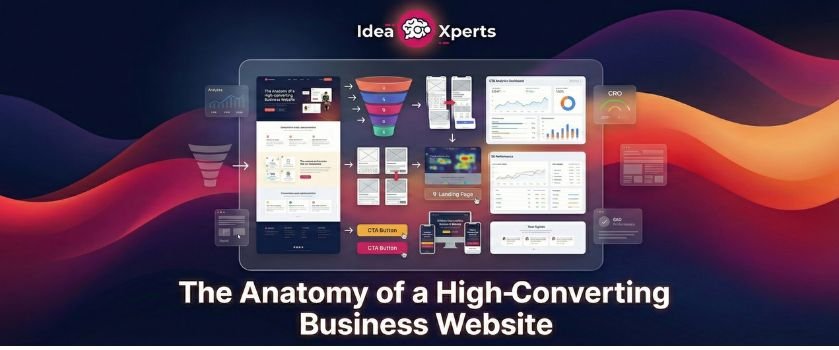
A high converting business website is built with strategy, psychology, user experience, and performance working together. Before development begins, working through a structured web development checklist ensures none of these critical elements are missed. Every section has a purpose. Every element guides the visitor toward taking action.
In this guide, we will break down the exact structure that makes a business website convert at a higher level.
1. A Crystal Clear Value Proposition Above the Fold
The first few seconds decide everything.
When a visitor lands on your website, they instantly ask three questions in their mind.
- What does this company do
- Is this relevant to me
- Can they solve my problem
Your above the fold section must answer these immediately.
- A high converting hero section includes
- A clear headline that communicates your core value
- A short supporting message that explains the outcome for the client
- A strong primary call to action
- Visual context that supports your brand positioning
Choosing the right hero image plays a significant role in communicating your brand’s positioning within seconds of arrival.
Weak websites try to sound clever. Strong websites focus on clarity.
For example, instead of vague messaging, communicate the transformation your client will experience after working with you.
Visitors should never have to guess what you offer. A detailed website design checklist helps ensure every client-facing element communicates clarity from the very first impression.
2. Strategic Website Structure That Guides Decisions
A high converting website is designed like a guided journey.
Visitors move through stages of awareness, interest, trust, and action. This process closely aligns with proven marketing frameworks like the AIDA model that many successful websites use to guide user decisions. Your website structure should support this progression naturally.
An effective structure usually includes
- Introduction and positioning
- Proof of expertise
- Services and solutions
- Case studies or results
- Trust signals and credibility
- Clear call to action
When information is presented in the right order, decision making becomes easier.
Confusion reduces conversions. Structure increases them.
This is one of the biggest differences between websites built with strategy and those built only for design.
3. Conversion Focused Design and Visual Hierarchy
Good design is not decoration. It is direction.
Visual hierarchy determines what users notice first, second, and third. Without it, users feel overwhelmed and leave quickly.
- High converting websites prioritize
- Readable typography
- Clear spacing between sections
- Contrasting call to action buttons
- Logical content flow
- Mobile friendly layouts
Your design should guide attention toward the actions that matter most such as contacting your team, requesting a proposal, or booking a consultation.
Great design quietly leads users without them realizing it. This begins with brand identity itself. Our logo design packages are crafted to ensure your visual foundation communicates credibility before a visitor reads a single word.
4. Messaging That Focuses on Outcomes Instead of Services
Most business websites talk about themselves.
High converting websites talk about the customer.
This shift dramatically improves engagement and conversions.
Instead of listing services, explain the results clients achieve.
For example
We build websites
versus
We build websites that increase leads, authority, and revenue
Outcome driven messaging works because visitors are not searching for services. They are searching for solutions to problems.
Your website copy should clearly communicate
- Who you help
- What problem you solve
- What results clients can expect
- Why your approach works
This is where many businesses lose potential customers.
They explain features instead of communicating transformation.
5. Trust Signals That Reduce Buying Anxiety
Before someone contacts a business, they need reassurance.
Trust signals help visitors feel confident in their decision.
Strong trust elements include
- Client testimonials
- Case studies showing measurable results
- Brand partnerships
- Awards or recognitions
- Client success stories
- Portfolio examples
Social proof is one of the most powerful psychological drivers of conversions.
When visitors see that others trust your business, their hesitation decreases significantly.
This is why high performing agency websites highlight results early in the experience.
6. Calls to Action That Are Clear and Repeated
A common mistake many websites make is hiding the call to action.
Visitors should never wonder what to do next.
A high converting website includes multiple opportunities to take action throughout the page.
Examples of strong calls to action include
- Start Your Project
- Book a Strategy Call
- Get a Free Website Audit
- Request a Proposal
These should appear
- In the hero section
- After explaining services
- Following case studies
- At the end of the page
Consistency is key. The message and action should remain clear across the entire website.
7. Speed, Performance, and Mobile Experience
Even the best design will fail if the website is slow or difficult to use on mobile.
Today, most visitors access websites through smartphones. A poor mobile experience leads to higher bounce rates and lower search rankings.
High converting websites prioritize
- Fast loading pages
- Optimized images
- Responsive layouts
- Simple navigation on mobile
- Clean code structure
Speed directly impacts both user experience and SEO performance.
Businesses that invest in performance often see measurable improvements in conversion rates.
8. SEO Foundation That Brings Qualified Traffic
A beautiful website without traffic cannot generate results.
Search engine optimization ensures your ideal customers can discover your business online.
A high converting business website includes
- Keyword optimized pages
- Clear content hierarchy
- Internal linking structure
- Technical SEO optimization
- Helpful content that answers real questions
Our content marketing packages are structured to do precisely this, creating content that attracts qualified visitors and supports conversion at every stage.
SEO is not just about ranking. It is about attracting the right audience who are more likely to convert. Staying current with the latest SEO trends ensures your strategy continues to attract the right visitors as search behaviour evolves.
This is why content strategy plays a critical role in long term website success. However, executing this strategy requires the right partner, so learning how to choose an SEO company can save you from costly mistakes. For businesses evaluating where to invest, understanding how much SEO costs helps set realistic expectations for long term growth.
9. Lead Capture Systems That Turn Visitors Into Opportunities
Many websites lose potential clients simply because they do not capture interest effectively.
Your website should include multiple lead generation mechanisms such as
- Contact forms that are simple and quick
- Consultation booking options
- Downloadable resources or audits
- Email subscription opportunities
The goal is to convert anonymous visitors into identifiable leads that your business can nurture.
Even small improvements in lead capture can significantly increase revenue over time.
10. Continuous Optimization and Data Driven Improvements
The highest performing websites are never finished.
They evolve.
Conversion optimization involves testing and improving elements such as
- Headlines
- Layout structure
- Call to action placement
- Page speed
- User journey flow
Small changes can produce significant results when guided by data.
Businesses that continuously improve their website often outperform competitors who treat their website as a static project.
Final Thoughts
A high converting business website is not created by chance.
It is built through strategy, user psychology, strong messaging, performance optimization, and continuous improvement. Our web development packages are built around exactly these principles, designed to deliver websites that perform, not just impress.
When these elements work together, your website becomes more than a digital brochure. It becomes a powerful growth engine for your business.
Companies that focus on conversion focused design consistently generate more leads, stronger brand authority, and higher revenue from their online presence.
If your website is not producing the results you expected, the issue is rarely just design. Most of the time, it comes down to strategy, structure, and clarity.
And when those are aligned, the difference in performance can be dramatic. To ensure these elements are executed perfectly, knowing how to choose a web development company is just as important as the strategy itself. If you are ready to invest in a conversion focused website, understanding web design costs is a practical starting point for planning your project.