Key Takeaways
- The AIDA model improves SEO by influencing user behavior metrics Google cares about, including click-through rate, bounce rate, time on page, and overall engagement.
- Structuring content using Attention, Interest, Desire, and Action helps match search intent, keep users engaged, and guide them toward meaningful actions without harming UX.
- AIDA works best for blogs, service pages, and commercial investigation content, but it is not suitable for reference pages, breaking news, or utility-focused tools.
- Higher engagement and user satisfaction signals created by AIDA-based content support stronger long-term rankings, even in competitive search results.
- When applied strategically, the AIDA framework connects SEO, copywriting, and conversion optimization into a single system that drives both traffic growth and business results.
How to Rank on Google Using the AIDA Model (SEO + Copywriting Framework)
Ranking on Google today is no longer just about keywords and backlinks. It is about how users interact with your content once they land on it. That is where understanding how to rank on Google using the AIDA model becomes powerful. Google increasingly rewards pages that capture attention, keep users engaged, build trust, and drive meaningful actions.
I have worked on SEO projects where rankings improved not because we added more keywords, but because we restructured content using proven copywriting psychology. This guide explains how the AIDA model connects SEO, user behavior, and conversions into one ranking-focused strategy.
Quick Answer: Can You Rank on Google Using the AIDA Model?
Yes, you can rank on Google using the AIDA model, not because Google understands copywriting frameworks, but because it measures user behavior. AIDA improves click-through rate, reduces bounce rate, increases time on page, and drives engagement, all of which are indirect ranking signals Google values.
What Is the AIDA Model?
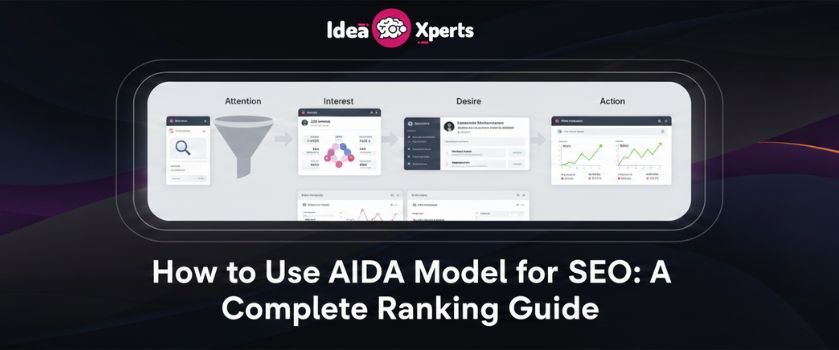
The AIDA model is a classic marketing and copywriting framework that describes how people move from awareness to action. AIDA stands for Attention, Interest, Desire, and Action. It was originally developed for advertising, but its principles are deeply aligned with how users consume content online today.
In simple terms, the AIDA framework mirrors human decision-making psychology. First, something grabs attention. Then, interest is built by relevance and clarity. Desire follows when value and trust are established. Finally, action happens when friction is removed.
In SEO copywriting, AIDA helps structure content so it flows naturally, keeps readers engaged, and guides them toward meaningful outcomes. Unlike random content blocks, AIDA gives your page a narrative arc, which is exactly how users prefer to consume information.
Why the AIDA Model Matters for SEO in 2026
Modern SEO is behavior-driven. Google does not just analyze what your content says, but how users respond to it. This is where the AIDA framework becomes strategically important.
Google Prioritizes Engagement Over Keywords Alone
Search engine optimization has evolved beyond keyword placement. Google looks at signals such as bounce rate, dwell time, scroll depth, and click-through rate. Pages that fail to engage users often struggle to maintain rankings, even with strong backlinks.
The AIDA model directly influences these metrics. Attention improves CTR in search results. Interest keeps users scrolling. Desire builds trust and perceived value. Action signals satisfaction and relevance.
AIDA Aligns With User Intent Optimization
Search intent optimization is about matching content to what users actually want at each stage of their journey. Informational users want clarity. Commercial users want reassurance. Transactional users want direction.
AIDA allows you to meet users where they are psychologically, not just contextually. This is why AIDA-based content often outperforms generic SEO pages, especially for competitive queries.
SEO Without Persuasion Is Incomplete
Many websites rank temporarily but fail to convert or retain traffic. That usually means SEO and copywriting are disconnected. When persuasion is layered on top of SEO using frameworks like AIDA, content performs better long-term.
This same principle applies across service websites. For example, pricing pages that explain value clearly often perform better than plain cost breakdowns, as seen in guides like plumbing website development cost discussions where clarity and persuasion matter
How the AIDA Model Aligns With Google’s Ranking Factors
Google’s algorithm does not read AIDA labels, but it absolutely measures the behaviors AIDA influences.
Attention and Click-Through Rate (CTR)
The Attention stage of AIDA directly affects how users interact with search results. Strong headlines and compelling meta descriptions increase CTR, which signals relevance to Google.
When users consistently choose your result over others, Google learns that your page better satisfies intent. This is especially important for competitive queries where multiple results target similar keywords.
Interest and User Engagement Signals
Once users land on your page, Interest determines whether they stay or leave. Clear introductions, structured subheadings, and logical flow keep users engaged.
Pages that maintain interest typically show better time on page and scroll depth. These engagement signals help reduce pogo-sticking, where users return to search results quickly, a behavior Google actively tracks.
Desire and Trust-Building Signals
Desire is built through value, authority, and proof. This includes examples, data, internal links, and clear explanations. Trust signals reduce hesitation and increase perceived quality.
This is why linking to relevant supporting content matters. For example, explaining design psychology alongside SEO often benefits from understanding how a hero image in web design creates an immediate emotional connection and establishes better visual hierarchy.
Action and Conversion Signals
While conversions themselves are not direct ranking factors, satisfied users who take action tend to stay longer, explore more pages, and return later. These behaviors reinforce content relevance.
Action also includes micro-conversions such as clicking internal links, navigating to related pages, or bookmarking content.
How to Apply the AIDA Model to SEO Content Step by Step
Applying AIDA to SEO is not about forcing a formula. It is about structuring content intentionally.
Step 1: Capture Attention in Search Results
Attention begins before users land on your website. Your page title, URL, and meta description must stand out without misleading users.
Use emotional triggers carefully. Curiosity, clarity, and specificity outperform clickbait. Promising value and delivering it consistently is key to sustainable rankings.
Step 2: Build Interest With Content Structure
Interest is sustained through readability and flow. Short paragraphs, meaningful subheadings, and logical sequencing keep users engaged.
This is where many SEO pages fail. They dump information without structure. AIDA-based content, on the other hand, guides readers naturally through complexity.
Step 3: Create Desire Through Value and Proof
Desire grows when users see clear benefits, examples, and outcomes. This includes practical explanations, comparisons, and real-world context.
For service-based topics, explaining cost transparency and value often increases trust. Articles that explain how much web design costs perform better when they justify the investment through value and expertise instead of just listing numbers.
Step 4: Drive Action With SEO-Friendly CTAs
Action does not always mean “buy now.” It can mean reading further, contacting you, or exploring related resources.
Effective CTAs align with intent. Informational pages use softer CTAs, while commercial pages guide users more directly. Poorly placed or aggressive CTAs often increase bounce rate instead of conversions. If you want to transform your brand’s narrative into a lead-generating machine, our content marketing packages provide the perfect blend of AIDA-driven strategy and professional execution to drive real business results.
Using the AIDA Model for On-Page SEO Optimization
AIDA also improves technical and structural SEO when applied correctly.
Keyword placement becomes more natural when aligned with Attention and Interest sections. Internal linking supports Desire by reinforcing authority and topical depth. Content flow reduces friction and improves user satisfaction.
This is why SEO strategy should not be separated from pricing and investment decisions. Businesses evaluating how much SEO costs often underestimate how significantly content quality and AIDA-based structure impact their overall ROI.
Why AIDA-Based Content Supports Long-Term SEO Investment
SEO is not a short-term tactic. It is a compounding asset. AIDA-based content tends to age better because it is user-focused rather than algorithm-focused.
This is also why many businesses that understand the reasons why your business should invest in SEO focus heavily on psychological content frameworks like AIDA to ensure long-term growth.
AIDA Model for Blog Posts vs Landing Pages
The AIDA model works across content types, but how you apply it changes depending on whether the page is informational or conversion focused. Treating blog posts and landing pages the same is a common SEO mistake.
Applying the AIDA Model to Blog Content
Blog posts are usually designed for informational or investigational intent. The goal is not immediate conversion, but engagement, trust, and authority. In this context, AIDA works as a progressive engagement framework.
Attention is captured through strong introductions, compelling headlines, and relevance to the search query. Interest is maintained through structured sections, examples, and clear explanations. Desire is built by demonstrating expertise, showing real use cases, and linking to related authoritative content. Action is typically soft, such as encouraging readers to explore another guide, download a resource, or read a related article.
For example, an SEO blog post that explains pricing, strategy, or frameworks performs better when it educates first and nudges later. Hard CTAs at the top often increase bounce rate and reduce trust.
Applying the AIDA Model to Landing Pages
Landing pages operate much closer to the Action stage. Users arrive with commercial intent and expect clarity, reassurance, and direction.
Attention on landing pages comes from visual hierarchy, headlines, and layout. Interest is created by clearly explaining the offer and its relevance. Desire is built through benefits, testimonials, proof points, and guarantees. Action is explicit and focused, usually one primary CTA.
Unlike blog posts, landing pages should remove distractions. Navigation is often minimized, and content is tightly aligned with the conversion goal. Using AIDA here helps reduce friction and increase conversion rate optimization without sacrificing SEO fundamentals.
AIDA vs PAS vs PASTOR for SEO Copywriting
Many marketers ask whether AIDA is better than PAS or PASTOR for SEO. The answer depends on intent, content type, and user awareness level.
AIDA Framework Explained for SEO
AIDA is best suited for full-funnel SEO content. It works well for pillar pages, long-form blogs, service pages, and educational resources. Its strength lies in guiding users naturally from curiosity to action while maintaining engagement throughout the page.
Because AIDA aligns closely with user behavior metrics, it is particularly effective for improving time on page, scroll depth, and internal navigation.
PAS Copywriting Model and SEO Use Cases
PAS stands for Problem, Agitate, Solve. It works well for pain-driven content, especially in niches where users are already aware of their problem.
For SEO, PAS is effective for landing pages and ads, but it can feel repetitive or aggressive in long-form informational content. Overuse of agitation can also increase bounce rate if users feel manipulated.
PASTOR Framework and Conversion Pages
PASTOR adds depth to PAS by incorporating story, transformation, and results. It is powerful for sales pages, webinars, and high-ticket offers.
However, PASTOR requires strong storytelling and proof. When used incorrectly, it can overshadow search intent and reduce SEO clarity.
Which Copywriting Model Is Best for Ranking on Google?
For SEO-driven content, AIDA is usually the most flexible and sustainable framework. PAS and PASTOR work best as supporting models within specific sections, not as full-page structures for informational content.
In practice, high-performing pages often blend frameworks, but AIDA provides the strongest backbone for search-focused content.
Common Mistakes When Using the AIDA Model for SEO
While AIDA is powerful, it is often misused. These mistakes can actually harm rankings instead of improving them.
Over-Optimizing for Persuasion Instead of Intent
Some content focuses so heavily on persuasion that it ignores search intent. Users looking for information feel pushed into actions too early, leading to frustration and exits.
SEO content should always satisfy intent first, then persuade second.
Treating AIDA as a Rigid Formula
AIDA is a framework, not a checklist. Forcing every paragraph into a strict sequence often results in unnatural content flow.
The best AIDA-based SEO content feels organic. Readers should not notice the framework. They should only feel clarity and momentum.
Weak or Misaligned CTAs
CTAs that do not match intent reduce effectiveness. Informational readers are not ready for sales-heavy CTAs. Commercial readers need clarity, not vague prompts.
Aligning CTAs with the correct AIDA stage improves both engagement and conversions.
How AIDA Improves SEO Metrics That Google Cares About
Google does not rank copywriting frameworks directly, but it absolutely ranks pages based on user behavior outcomes. The AIDA model works for SEO because it improves how users interact with content once they land on a page. These interaction signals help Google understand whether a page satisfies search intent better than competing results.
Lower Bounce Rate Through Better Content Flow
One of the biggest SEO challenges is the high bounce rate. When users land on a page and feel confused or overwhelmed, they leave quickly. The Attention and Interest stages of AIDA address this problem directly.
By clearly explaining what the page is about, who it is for, and why it matters, users immediately understand relevance. This reduces early exits and encourages users to continue reading. Pages with lower bounce rates send stronger quality signals to Google, especially for competitive queries.
Higher Click-Through Rate From SERPs
Click-through rate begins before users even visit your website. AIDA-informed titles and meta descriptions focus on benefits, clarity, and intent matching, rather than generic keyword stuffing.
When users consistently choose your result over others, Google interprets this as a relevance signal. Over time, higher CTR can improve average position, particularly when multiple pages target similar keywords with similar backlink profiles.
Improved Time on Page and Engagement Signals
The Desire stage of AIDA is where content depth matters most. Structured sections, examples, comparisons, and practical explanations encourage users to scroll, read, and engage.
When users spend more time on a page, scroll deeper, and interact with internal links, Google receives strong signals that the content is valuable. This improved engagement often correlates with better rankings, especially for long-form informational and commercial investigation queries.
Better Conversion and User Satisfaction Signals
While conversions themselves are not direct ranking factors, they often reflect user satisfaction. When users find exactly what they need and take action, they are more likely to return, explore additional pages, or share the content.
These behaviors contribute to stronger long-term SEO performance by reinforcing relevance, trust, and brand familiarity in Google’s ecosystem.
When the AIDA Model Does NOT Work for SEO
The AIDA model is powerful, but it is not universal. Using it where it does not belong can actually hurt usability and rankings. Knowing when not to apply AIDA improves credibility and strategic decision-making.
Purely Informational or Reference Content
Documentation, glossaries, dictionaries, and technical reference pages are designed for quick access to specific information. Users arrive with a narrow goal and expect immediate answers.
Adding persuasive elements or narrative progression in these cases often increases friction. For such pages, clarity, simplicity, and fast information retrieval matter more than engagement storytelling.
News or Time-Sensitive Content
Breaking news and time-sensitive updates require speed and directness. Users want the facts immediately, not a guided journey through Attention, Interest, Desire, and Action.
Applying AIDA here can delay critical information, frustrate users, and increase bounce rate. For news-style content, inverted pyramid structures usually perform better.
UX-First Utility Pages
Dashboards, calculators, tools, and interactive utilities should prioritize usability over persuasion. These pages exist to help users complete a task as efficiently as possible.
AIDA works better around these pages, such as in onboarding content or supporting blog posts, rather than inside the tools themselves.
How IdeaXperts Uses the AIDA Model for SEO Growth
At IdeaXperts, we do not treat AIDA as a copywriting trick. We use it as a strategic SEO framework that aligns content, user psychology, and measurable performance outcomes.
Intent Mapping Before Content Creation
Every SEO project begins with understanding search intent. We map keywords to user expectations and buyer journey stages before writing a single word. This ensures the AIDA structure matches how users think, not how algorithms guess.
This step prevents common issues like ranking without converting or attracting the wrong type of traffic.
AIDA-Based Content Structuring for SEO Pages
We apply the AIDA model to page structure, not just copy. Headlines capture Attention, introductions build Interest, core sections establish Desire through value and proof, and CTAs guide Action naturally.
This approach works particularly well for service pages, pricing content, and long-form educational resources where clarity and trust directly impact conversions.
Performance Tracking and Continuous Optimization
AIDA is not static. We continuously monitor engagement metrics such as bounce rate, time on page, CTR, and conversion paths. When performance dips, we refine specific AIDA stages rather than rewriting entire pages.
This data-driven approach allows us to improve rankings and conversions simultaneously.
Scalable SEO Solutions With Clear Pricing
We combine AIDA-based strategy with transparent, scalable SEO solutions. Businesses that want structured growth often explore our SEO packages because they align long-term optimization with measurable ROI
Our goal is not just higher rankings, but sustainable growth driven by content that resonates with both users and search engines.
FAQs – Ranking on Google Using the AIDA Model
Can the AIDA model improve SEO rankings?
Yes. The AIDA model improves engagement metrics such as CTR, bounce rate, and time on page, which are indirect ranking signals Google uses to assess content quality.
Is AIDA better than PAS for SEO?
AIDA is generally better for long-form and informational SEO content, while PAS works better for short, pain-focused landing pages or ads.
Does Google understand copywriting frameworks like AIDA?
Google does not understand frameworks directly, but it measures user behavior. AIDA improves behavior signals that influence rankings.
Can AIDA reduce bounce rate?
Yes. By capturing attention and maintaining interest early, AIDA-based content reduces confusion and early exits.
Should every page use the AIDA model?
No. AIDA works best for content-driven pages. Utility pages, documentation, and tools often require simpler structures.
Final Thoughts: Using the AIDA Model as an SEO Strategy
Ranking on Google using the AIDA model is not about manipulating users. It is about aligning SEO with how people actually think and decide. When content captures attention, builds interest, creates desire, and guides action naturally, both users and search engines respond positively. Used strategically, AIDA becomes a long-term SEO advantage, not just a copywriting technique.